We’ve all been there. You’re in a Pilates class, perhaps attempting a challenging exercise like the Teaser or a complex series on the Reformer. You’re pushing, straining, muscles trembling, trying desperately to hold the form, but something feels off. Your neck is tensing, your shoulders are creeping up to your ears, and despite your best efforts, you just can’t quite find that elusive core connection. In that moment of struggle, an instructor often offers a simple, yet profound cue: "Don't forget to breathe."
It sounds so basic, doesn’t it? Breathing is automatic. We do it every second of every day without conscious thought. Yet, in the controlled, intentional environment of a Pilates session, breath becomes a powerful, often underutilized, tool. It’s not just about getting air in and out; it's about maximizing oxygen for deeper muscle engagement, regulating your nervous system, and ultimately, unlocking a more profound, efficient, and enjoyable movement experience. As Pilates practitioners and instructors, understanding the mechanics and art of breathwork is fundamental to truly mastering the method.
The Powerhouse of Respiration: Why Breath is Your Best Ally
Joseph Pilates himself emphasized breath as the first principle of his method, declaring, "Above all, learn how to breathe correctly." This wasn't just philosophical advice; it was a directive rooted in physiological understanding. Proper breathwork in Pilates is a sophisticated dance between your diaphragm, intercostals, and deep core muscles. When executed correctly, it serves several critical functions:
Optimal Oxygen Delivery: Efficient breathing ensures your muscles receive a steady supply of oxygen, delaying fatigue and allowing for sustained effort and deeper contractions.
Core Activation: A full, controlled exhale naturally engages your transversus abdominis and pelvic floor, creating a stable foundation from which all movement originates.
Nervous System Regulation: Deep, diaphragmatic breathing activates the parasympathetic nervous system, promoting relaxation, reducing stress, and improving focus – essential for mindful movement. This connection, often linked to the vagus nerve, helps shift your body from a "fight or flight" state to one of "rest and digest," fostering a calmer, more receptive body for exercise.
Spinal Mobility and Articulation: The gentle expansion and compression of the rib cage with each breath aids in spinal mobility, particularly in exercises designed to articulate the spine.
Strategic Breathwork Techniques for Enhanced Engagement
Let's dive into some specific strategies you can implement, both in your own practice and when guiding clients, to harness the full potential of breath.
1. The Lateral Breath: Cultivating Core Stability
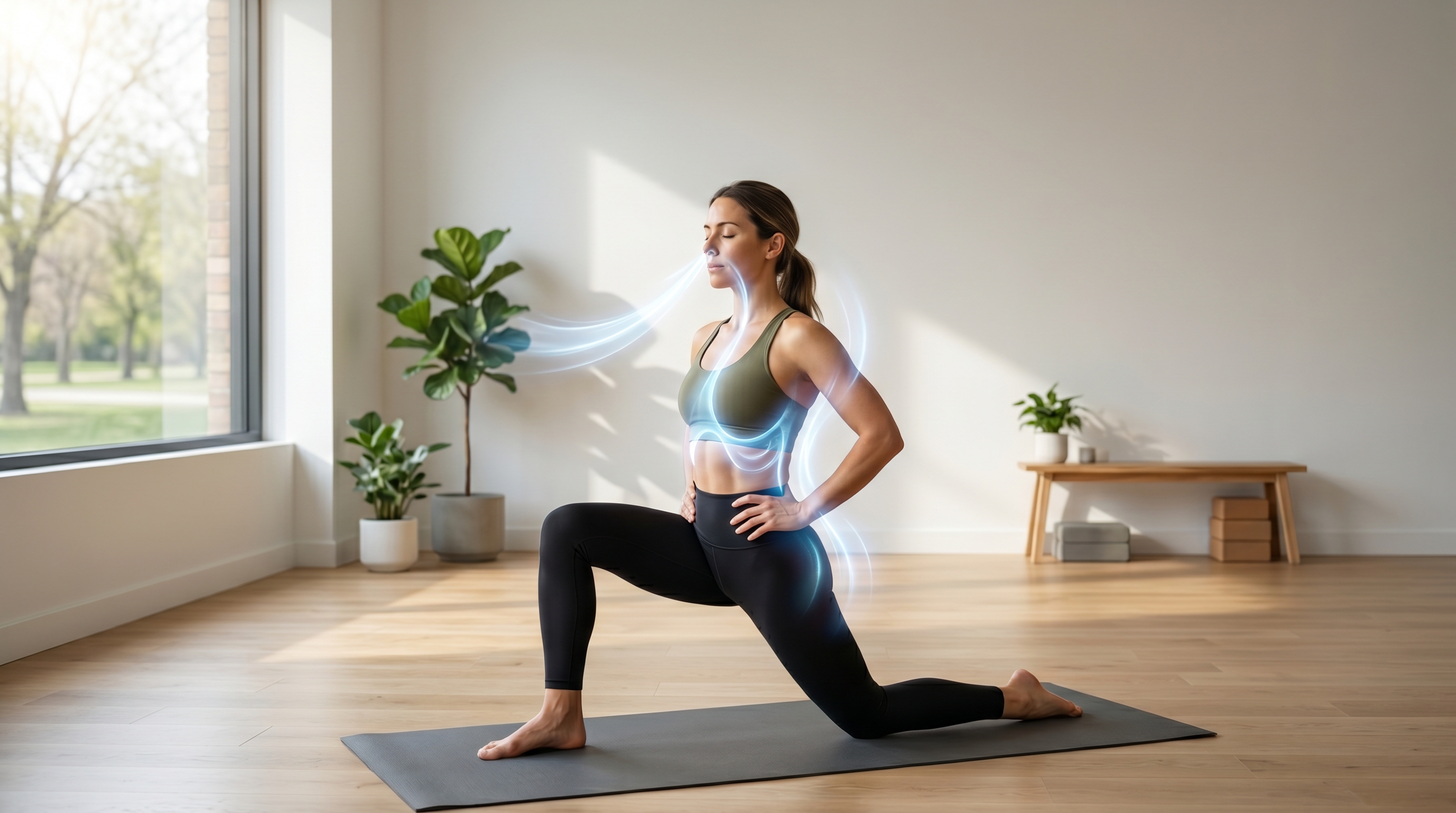
Unlike everyday breathing, which often involves significant abdominal expansion, Pilates emphasizes a lateral or posterior-lateral breath. This technique allows you to maintain abdominal engagement while still taking a full, deep breath.
How to Practice: Lie on your back with knees bent, feet flat. Place your hands on your lower ribs, fingers gently wrapping around the sides. As you inhale, focus on expanding your rib cage outwards and backwards, pushing into your hands and the mat, without allowing your belly to balloon excessively. As you exhale, feel your ribs draw in and down, maintaining a gentle scoop of your abdominals.
In Action: This breath is crucial during exercises like the Hundred, where you need to maintain a strong abdominal scoop while breathing deeply, or during Plank variations, to stabilize the torso without collapsing.
2. The Exhale for Deep Core Connection
The exhale is arguably the most powerful phase of the Pilates breath. A full, complete exhale is what truly activates your deep core muscles – the transversus abdominis and pelvic floor – creating that internal corset of support.
How to Practice: Imagine you're trying to gently zip up a tight pair of jeans or deflate a balloon completely. As you exhale, feel a subtle lift through your pelvic floor and a drawing in and up of your lower abdominals. Don't just let the air fall out; actively press it out, feeling your core engage more deeply as the last bit of air leaves your lungs.
In Action: Pair your longest, strongest exhale with the peak effort of an exercise. For example, as you roll up into a Roll-Up, exhale fully to deepen your abdominal scoop and support your spine. Or, during a heavy spring leg press on the Reformer, exhale as you press out to find more power and stability.
3. Rhythmic Breath Pairing: Synchronizing Movement and Control
Pilates movements are designed to be fluid and controlled, and breath is the conductor of this orchestra. Synchronizing your breath with each phase of an exercise enhances efficiency, control, and muscle engagement.
General Guideline: Inhale to prepare or lengthen; exhale on the effort or contraction. However, this isn't rigid; sometimes you'll inhale into a stretch or exhale to deepen a release. The key is intentionality.
Example: In the Single Leg Stretch, inhale as you switch legs (preparation/lengthening), then exhale as you pull the knee towards your chest, deepening your abdominal connection and finding stability. In the Shoulder Bridge, inhale to prepare, exhale as you articulate your spine up, feeling each vertebra lift, and then inhale at the top before exhaling to roll down.
An 'In Practice' Vignette: The Roll-Up Revelation
I remember working with a client, Sarah, who consistently struggled with the Roll-Up. Her neck would strain, her shoulders would hunch, and she'd inevitably "plop" down rather than rolling with control. We'd tried various modifications, but one day, I focused solely on her breath. "Before you even think about lifting your head," I instructed, "take a deep, lateral inhale to prepare. Now, as you begin to peel off the mat, initiate with the longest, most deliberate exhale you can manage. Feel your ribs knit, your abdominals scoop deeply, and imagine that exhale pulling you up and over your legs."
The transformation was immediate. Her neck relaxed. Her shoulders stayed down. And for the first time, she rolled up with a newfound sense of control, her spine articulating beautifully. The breath wasn't just a background function; it was the primary engine, providing the stability and lift she needed. It wasn't about strength; it was about smart engagement, driven by breath.
Your Breath, Your Powerhouse
Breathwork in Pilates is far more than just a mechanical necessity. It is the rhythmic, intelligent force that drives every movement, connects mind to body, and unlocks deeper levels of strength, control, and flexibility. By consciously practicing lateral breathing, utilizing the full power of your exhale, and thoughtfully pairing your breath with movement, you transform your practice from a series of exercises into a truly integrated, holistic experience.
Don't underestimate the profound impact of this fundamental principle. Make breath your conscious partner in every movement, both on and off the mat. Pay attention, experiment, and allow your breath to guide you to new depths of understanding and engagement within your own amazing body. Your Pilates journey will thank you for it.